The story
Bossam is a Korean main with a clear sense of place. Bossam means wrapped and commonly refers to tender boiled or simmered pork served with cabbage and condiments. It is strongly associated with kimjang season, when families traditionally prepare large quantities of kimchi and eat pork alongside freshly seasoned cabbage. The recipe below keeps the defining ingredients and technique intact while giving practical metric quantities and enough detail for a home cook to judge texture, seasoning and doneness rather than simply follow a timer.
Ingredients
- 900 g pork bellyskin on or off
- 1800 ml water
- 45 g doenjang
- 180 g onionhalved
- 30 g Garliccrushed
- 20 g gingersliced
- 80 g Spring onions
- 1 tsp black peppercorns
- 16 piece napa cabbage leavessalted or briefly blanched
- 100 g ssamjang
- 4 piece raw garlicthinly sliced
- 2 piece green chillisliced
Method
Put the pork belly in a pot
Put the pork belly in a pot just large enough to hold it. Add water, doenjang, onion, garlic, ginger, spring onions and peppercorns and bring slowly to a boil, skimming any grey foam.
Tip: Rest the pork before slicing and keep the poaching liquid gently moving rather than violently boiling. Avoid: Boiling aggressively dries the meat and shreds the exterior; slicing immediately makes the slab fall apart; oversalting cabbage can dominate every wrap.Lower to a gentle simmer, partially cover
Lower to a gentle simmer, partially cover and cook for 55–65 minutes. Keep the liquid below a hard boil so the fat softens without the meat becoming ragged.
Check the pork by inserting a thin
Check the pork by inserting a thin skewer into the thickest part; it should slide in easily but the slab should still hold together for slicing. Lift out and rest for 10 minutes.
While the pork rests, rinse salted cabbage
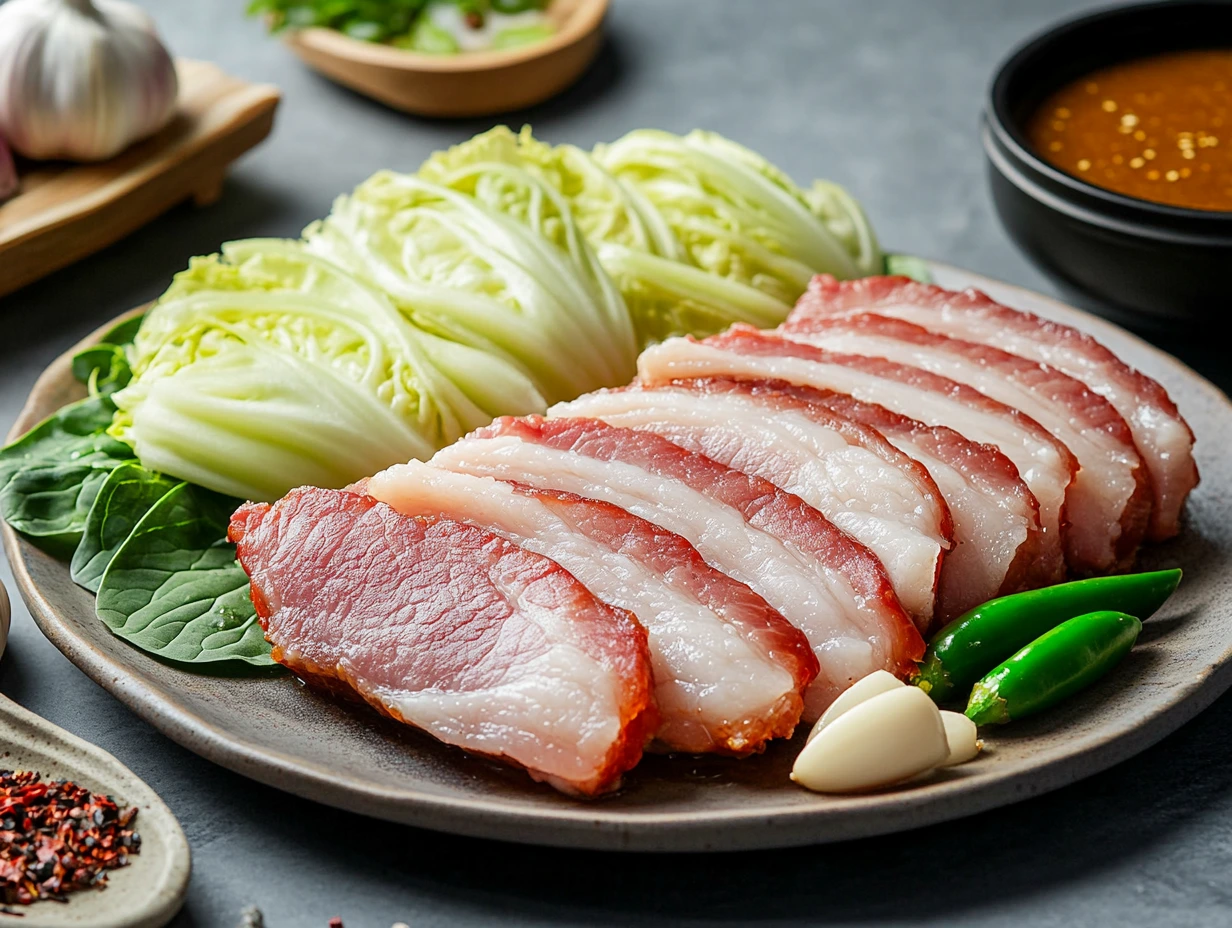
While the pork rests, rinse salted cabbage leaves if necessary and squeeze them dry. Arrange cabbage, ssamjang, sliced garlic and chilli on the table.
Slice the pork across the grain into
Slice the pork across the grain into pieces about 6–8 mm thick. If the fat has become very soft, use a sharp knife and wipe it between cuts for clean slices.
Serve warm
Serve warm. To eat, place a slice of pork in cabbage, add a small dab of ssamjang, garlic or chilli, fold and eat in one or two bites.
Look for: A skewer enters easily, the lean is tender and moist, and the fat is translucent and soft without dissolving away.
Nutrition
per serving
Estimated from the listed ingredients and default serving size. Actual values vary with brands, trimming, absorption and cooking losses.