The story
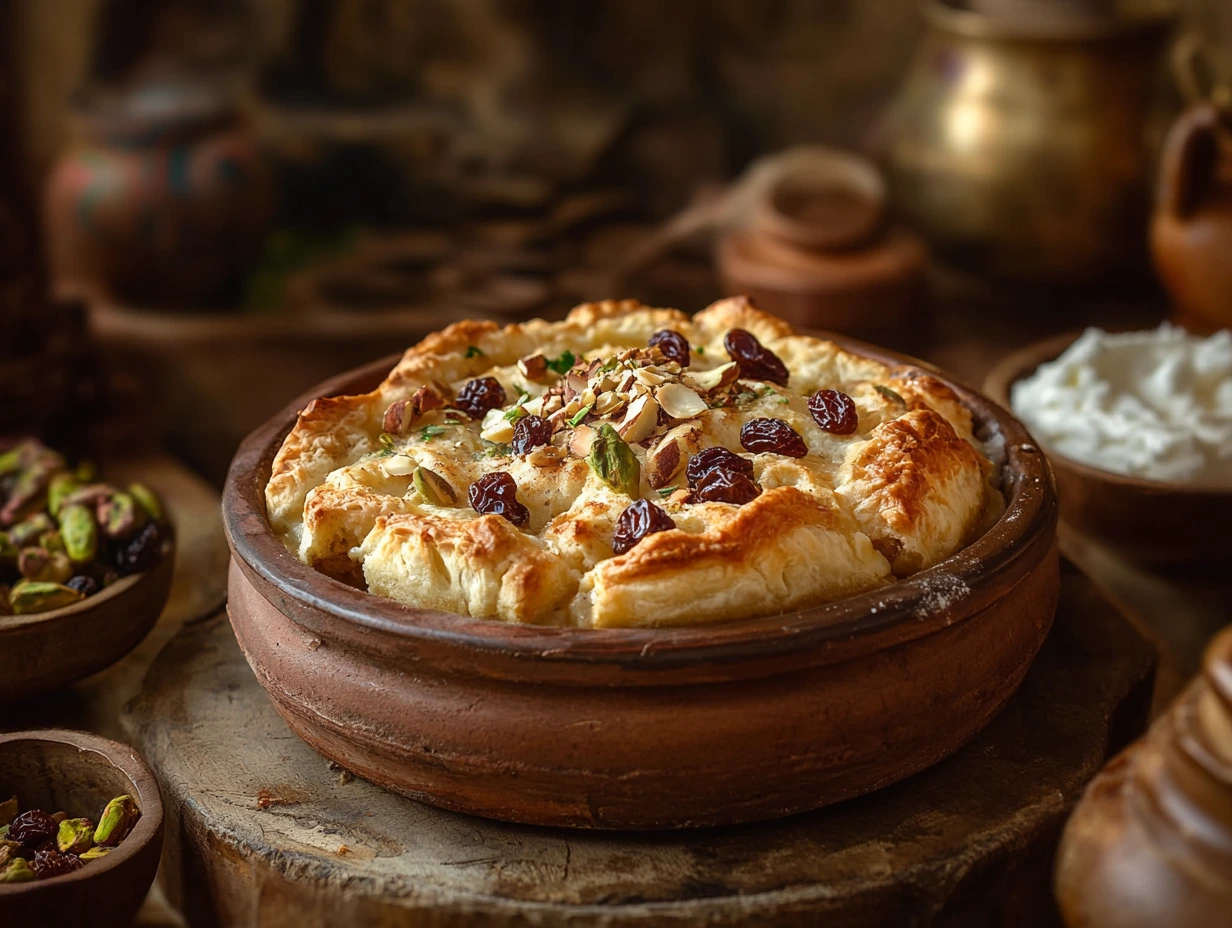
The dessert's name means 'mother of Ali' and is attached to a medieval court legend, though the precise story varies. Whatever its origin, the modern dish turns bread or puff pastry into a rich milk pudding suited to large gatherings. It is famous for simultaneous textures: the base softens into custard while exposed pastry and nuts brown on top. Cream, raisins and coconut make it more lavish than ordinary bread pudding. Umm Ali is served warm at buffets, Ramadan gatherings, hotels and family celebrations. Large trays make it naturally communal.
Ingredients
- Base
- 300 g puff pastrybaked until crisp, or use croissants · 300 g puff pastry, baked until crisp, or use croissants
- Custard
- 650 ml whole milk650 ml whole milk
- 150 ml double cream150 ml double cream
- 90 g caster sugar90 g caster sugar
- 5 ml vanilla extract5 ml vanilla extract
- Filling
- 55 g raisins55 g raisins
- 80 g mixed nutsalmonds, pistachios or hazelnuts, chopped · 80 g mixed nuts, almonds, pistachios or hazelnuts, chopped
- 35 g desiccated coconutoptional but common · 35 g desiccated coconut, optional but common
- Finish
- 3 g ground cinnamon3 g ground cinnamon
- Seasoning
- to taste pinch fine sea saltfine sea salt
Method
Bake the pastry
Bake puff pastry at 200°C / 392°F until fully risen, dry and golden, usually 18 to 22 minutes. Cool, then break into rough pieces.
Look for: Texture, aroma and colour should match the dish: tender where simmered, crisp where fried, glossy where sauced and bright where finished with herbs or lemon. Tip: Taste with the normal accompaniment, such as bread, rice, salad or sauce, because Egyptian dishes are designed as complete plates. Avoid: Do not rush the heat stage or rely only on time; check doneness, texture and seasoning before moving on.Layer the dish
Put pastry pieces in a baking dish with raisins, nuts and coconut. Keep the pieces uneven so some soften and some crisp.
Look for: Texture, aroma and colour should match the dish: tender where simmered, crisp where fried, glossy where sauced and bright where finished with herbs or lemon. Tip: Taste with the normal accompaniment, such as bread, rice, salad or sauce, because Egyptian dishes are designed as complete plates. Avoid: Do not rush the heat stage or rely only on time; check doneness, texture and seasoning before moving on.Heat the milk
Bring milk, cream, sugar, vanilla and a pinch of salt just to a simmer. Stir until the sugar dissolves.
Look for: Texture, aroma and colour should match the dish: tender where simmered, crisp where fried, glossy where sauced and bright where finished with herbs or lemon. Tip: Taste with the normal accompaniment, such as bread, rice, salad or sauce, because Egyptian dishes are designed as complete plates. Avoid: Do not rush the heat stage or rely only on time; check doneness, texture and seasoning before moving on.Soak briefly
Pour the hot milk mixture over the pastry and leave for 5 minutes so the lower layer absorbs liquid while the top remains visible.
Look for: Texture, aroma and colour should match the dish: tender where simmered, crisp where fried, glossy where sauced and bright where finished with herbs or lemon. Tip: Taste with the normal accompaniment, such as bread, rice, salad or sauce, because Egyptian dishes are designed as complete plates. Avoid: Do not rush the heat stage or rely only on time; check doneness, texture and seasoning before moving on.Bake until bubbling
Bake at 190°C / 374°F for 18 to 22 minutes until bubbling at the edges and golden on top.
Look for: Texture, aroma and colour should match the dish: tender where simmered, crisp where fried, glossy where sauced and bright where finished with herbs or lemon. Tip: Taste with the normal accompaniment, such as bread, rice, salad or sauce, because Egyptian dishes are designed as complete plates. Avoid: Do not rush the heat stage or rely only on time; check doneness, texture and seasoning before moving on.Serve warm
Dust with cinnamon and serve warm. Do not overbake until dry; the centre should be creamy.
Look for: Texture, aroma and colour should match the dish: tender where simmered, crisp where fried, glossy where sauced and bright where finished with herbs or lemon. Tip: Taste with the normal accompaniment, such as bread, rice, salad or sauce, because Egyptian dishes are designed as complete plates. Avoid: Do not rush the heat stage or rely only on time; check doneness, texture and seasoning before moving on.
Nutrition
per serving
Estimated from the upgraded Egyptian recipe for Umm Ali; verify with your preferred nutrition calculator before making formal nutritional claims.